
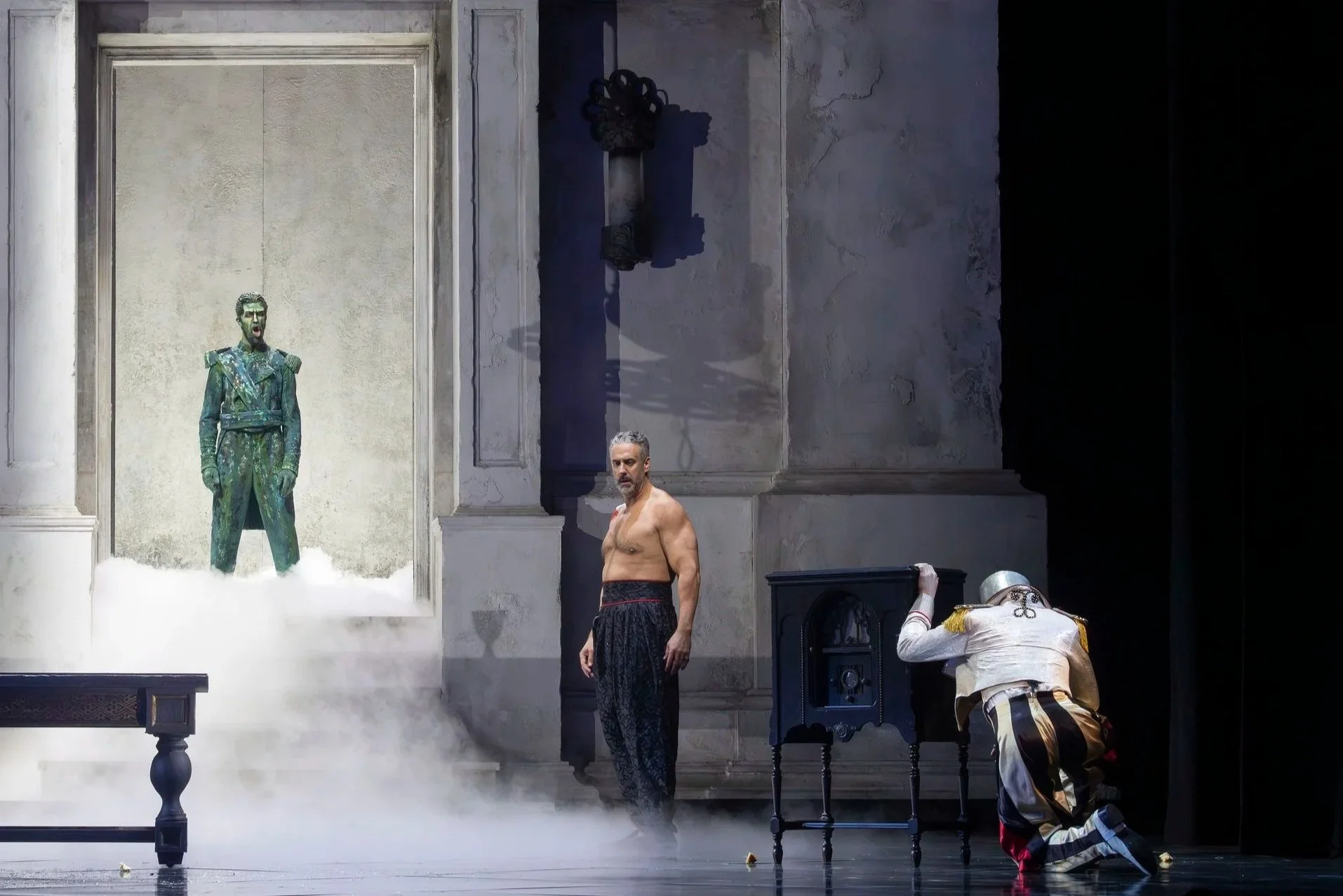
From left: David Leigh, Christian Van Horn, and Tommaso Barea in Don Giovanni (Cory Weaver/Lyric Opera of Chicago)
It is curious that the title character of Mozart’s Don Giovanni is so often described as an anti-hero. To butcher a phrase, the moral arc of an anti-hero is long, but it tends toward good. Anti-heroes do the right thing for the wrong reason, or the wrong thing for the right reason. Don Giovanni does nothing but the wrong things for the wrong reasons. He murders, connives, menaces, deceives, and assaults, all unrepentantly and out of pure selfishness. There is no question in my mind that he is the villain of the opera—a charming villain, likely thanks to Giovanni’s caddish librettist, the inimitable Lorenzo Da Ponte, but a villain nonetheless.

Christian Van Horn in Don Giovanni (Cory Weaver/Lyric Opera of Chicago)
To the credit of all involved, the Lyric Opera of Chicago’s season-opening production by Robert Falls did not shy away from this truth. For all the Don’s slippery suavity, his first scene sees him commit murder in cold blood and Falls has him hold a negligéed woman captive in his last scene—a shocking, but not surprising, touch. As the Don, two-time Girl of the Golden Met Award winner Christian Van Horn exuded debonair charisma and devil-may-care virility, but also utter disregard for the lives Giovanni bullets through with semi-automatic speed. A force in presence and in song, he admirably navigated the mile-a-minute Champagne Aria and mellow swells of “Deh, vieni alla finestra”. It should come as no surprise to those in the audience during the run that charismatic villains, Devils in particular, are CVH’s specialty.
Now, this may be attributed to direction, but it drove me half-mad that after Elvira shoots Giovanni in the right shoulder in the denouement, he continued to move his “injured” arm normally. Even if Elvira missed anything vital, Giovanni would be in no shape whatever to use his arm, at least not without significant pain. No wonder he was unable to climb up the dinner table to salvation.
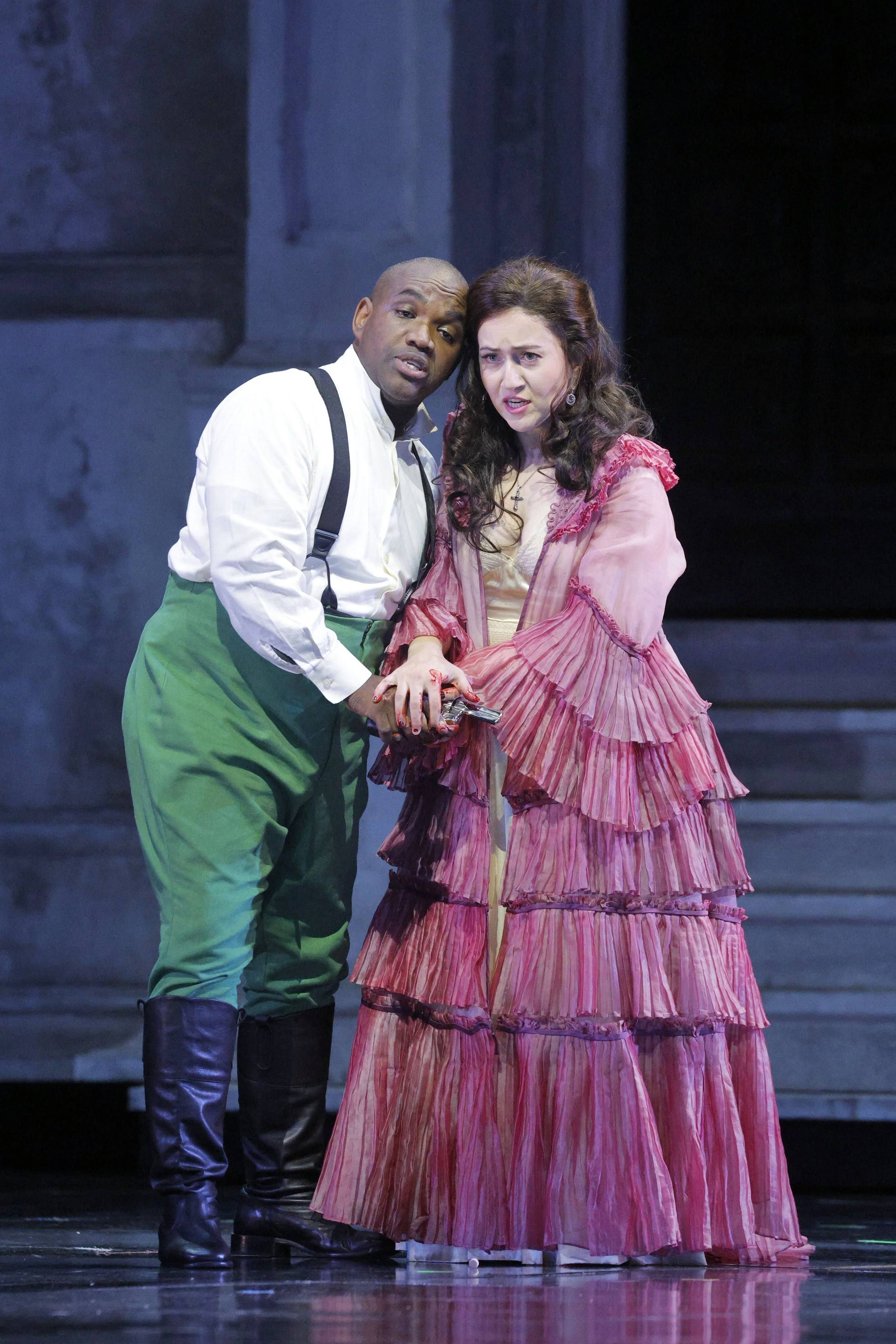
Lawrence Brownlee and Mané Galoyan in Don Giovanni (Cory Weaver/Lyric Opera of Chicago)
In the role of Donna Anna, Mané Galoyan tugged at the heartstrings with her portrait of a woman stuck in a bog of grief. She delivered a strong rendition of “Or sai chi l’onore,” but it was her sumptuous “Non mi dir” that brought the house down. Lawrence Brownlee, another Girl of the Golden Met Award winner and a Met and Lyric favorite alike, was a properly dithering Don Ottavio. In contrast to his epically insensitive character—two minutes after his fiancée’s father is brutally murdered, he’s already telling her to get over it—, Brownlee was unfailingly sensitive in his singing, lush even in the exposed tessitura of “Dalla sua pace,” and went on to earn one of the biggest ovations of the evening for his masterful execution of the florid runs in “Il mio tesoro”. Much like Hamlet (a true anti-hero), Ottavio is always Going To Do Something but never Doing It. If the Ghost in Hamlet had tired of his philosophizing son’s hemming and hawing and decided to just commit the “righteous” homicide himself, you would have Don Giovanni.
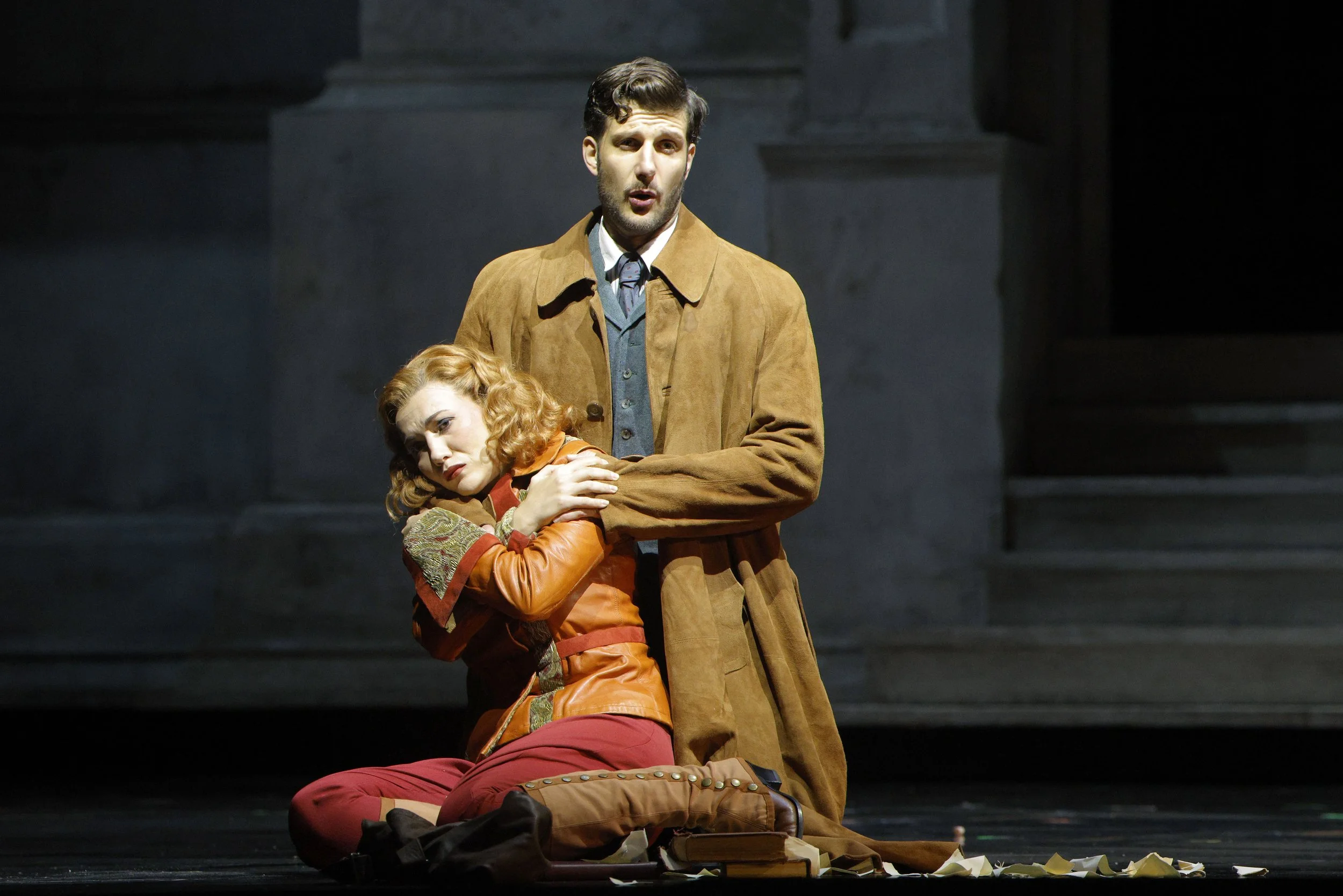
Nina Solodovnikova and Tommaso Barea in Don Giovanni (Cory Weaver/Lyric Opera of Chicago)
Nina Solodovnikova made an assured debut as Donna Elvira, bursting onto the scene on a motorcycle in red capris and an orange leather jacket. Let her say what she will, that woman will never go to a convent, I thought, and I did not change my mind. Her superb rendition of “Mi tradì quell’alma ingrata” was sleek yet full of tempestuous emotion, ranging from delicate piano laments of Giovanni’s infidelity to full-bodied fury. Ultimately, despite being the one who humiliates herself again and again by begging the Don to take her back, it is Elvira who saves everyone: Zerlina, Anna, the negligéed woman bound and gagged in Giovanni’s quarters. Solodovnikova had unexpectedly strong chemistry with the first-rate Tommaso Barea, who made an authoritative and plummy-voiced Leporello from his entertainingly kvetchy “Notte e giorno faticar” to his delightful Little Black Book Aria. I like to think that Leporello took all of his late master’s clothes to “fare il gentiluomo” (play the gentleman). If Giovanni made any will at all, which I doubt, he probably left his money to bordellos.
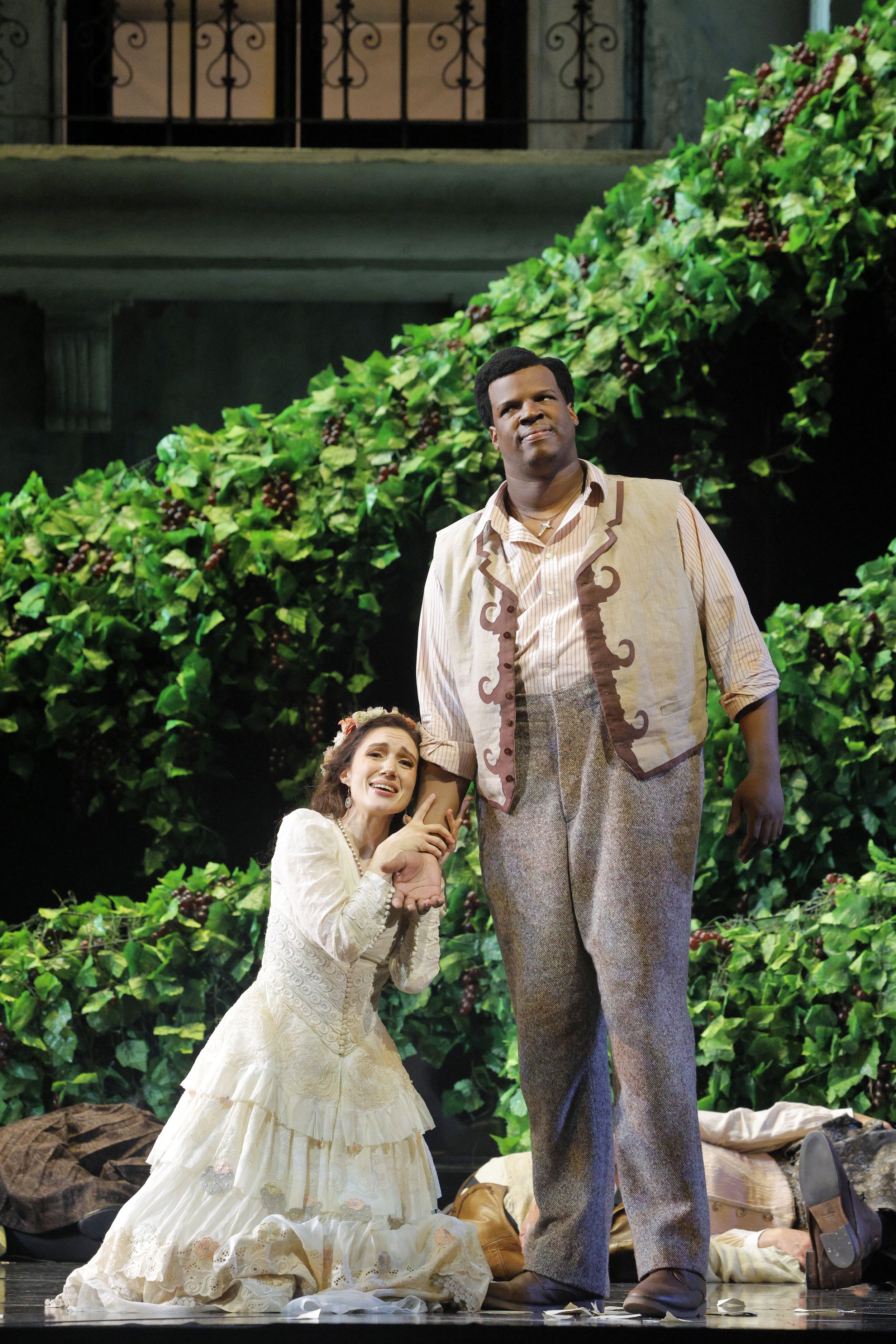
Anna El-Khashem and Christopher Humbert Jr. in Don Giovanni (Cory Weaver/Lyric Opera of Chicago)
In her Lyric debut, Anna El-Khashem skillfully grew Zerlina from an easily led and malleable naïf (ever heard of stranger danger?) to a commanding woman who knows how to handle the men in her life and gets the biggest gun to threaten Leporello with, while remaining irrepressibly coy and flirtatious. Vocally, she was at her silvery best in the runs of “Batti, batti,” topped off with a cadenza that understandably melted Masetto’s last dregs of resistance. Opposite her, Christopher Humbert Jr. was a hotheaded and vehement Masetto, displaying zero impulse control and a hearty, delicious bass-baritone. Together, El-Khashem and Humbert ran the gamut from besotted betrotheds to testy opponents to devoted allies. They made me think that, despite Zerlina’s roving eye and Masetto’s jealousy, the couple would be all right.
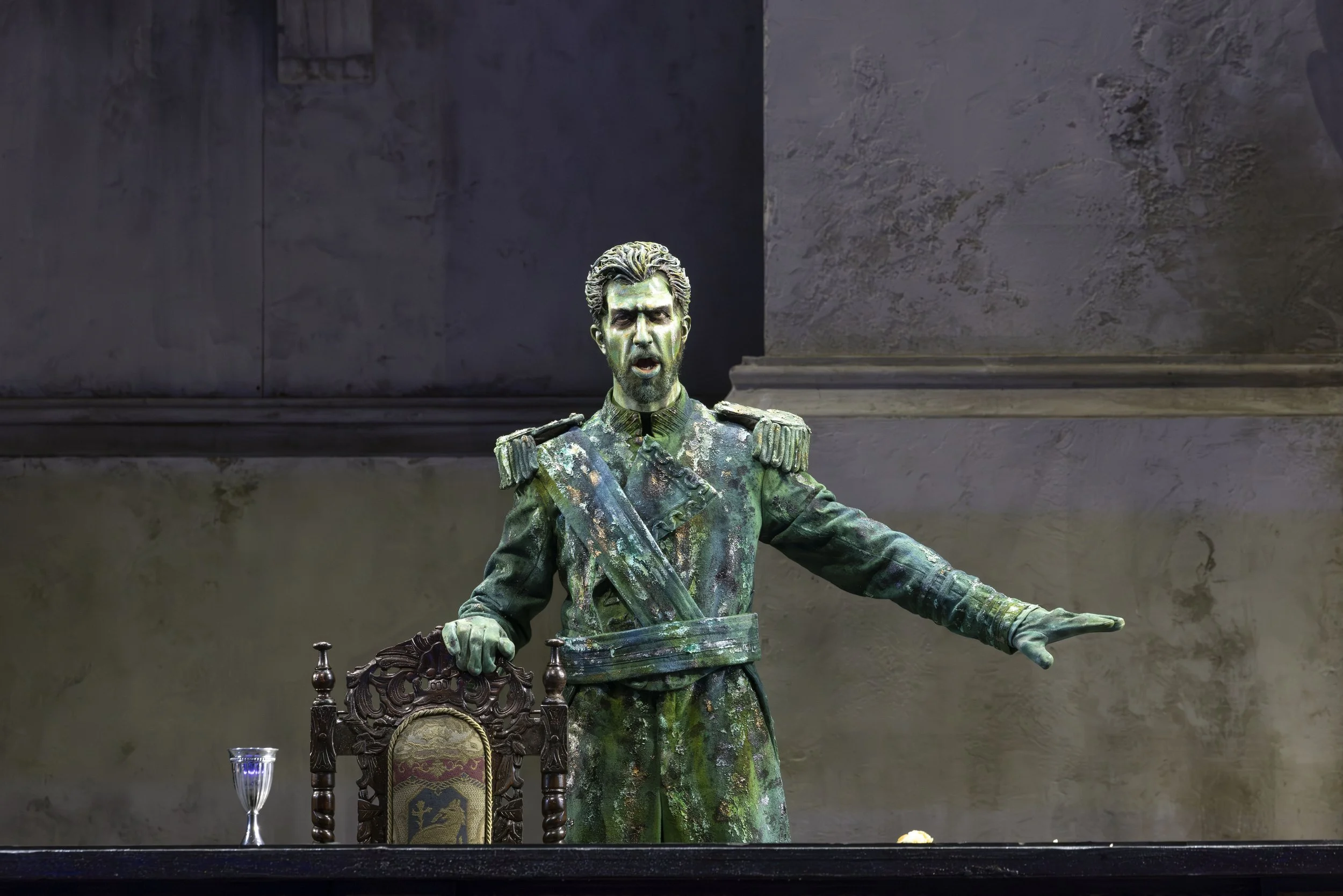
David Leigh in Don Giovanni (Cory Weaver/Lyric Opera of Chicago)
Multiple reviewers have beaten me to the epithet “stentorian” in describing David Leigh’s Lyric debut as the Commendatore, but it certainly fits. His imposing bass took on a nearly eerie ring when the Commendatore returned from the Otherworld to bring Giovanni to his doom. He carried himself with nobility in both senses of the word, a nobility that no Dondom and posturing could ever confer on Giovanni, although I remain baffled at the sheer amount of flowers that surrounded the Commendatore’s monument. The statue makeup on him was impressive, but looked as if the statue had been falling into disrepair for years. The time gap between the acts is virtually nil, as Act 1 ends with Giovanni framing Leporello for the former’s attack on Zerlina and Act 2 begins with Leporello threatening to leave over it. The Commendatore cannot possibly have been dead long enough for his statue to oxidize into Lady Liberty Green, and even if he were, Anna would have seen to it that there were no bird droppings on the statue.
On the podium was the Lyric’s Music Director, Maestro Enrique Mazzola, who led the Lyric Opera Orchestra with great verve and infectious joy in the music. The result was an exceptionally alive overture and evening, made only better by the wonderful Lyric Opera Chorus as the merry peasants at Zerlina’s wedding and fearsome demons awaiting Giovanni in Hell. I found “Batti, batti, o bel Masetto” to be rushed, although I can well understand wanting to get the perturbing aria over with. (“Gouge out my eyes, and I’ll kiss your hands,” Zerlina sings. Blech.)
Despite the quibbles I have laid out and the ones that I have not, there was one moment in the production that made it go straight to my heart. In the final scene, there is a floor console radio that plays selections from Mozart’s Le Nozze di Figaro and Martín y Soler’s Una Cosa Rara—courtesy of Da Ponte, librettist of both, in whose time the now-tragically forgotten Cosa Rara was a greater success than any Mozart opera. When the Commendatore enters to drag the Don to Hell (see uppermost picture), Leporello takes refuge behind and then beneath the radio. Although he has been complicit in most, if not all, of the Don’s crimes, the avenging angel pays him no mind and Leporello literally lives to tell the tale.
Music has the power to save us.
Special thanks go to Michael Solomon of the Lyric Opera of Chicago for according me press privileges.

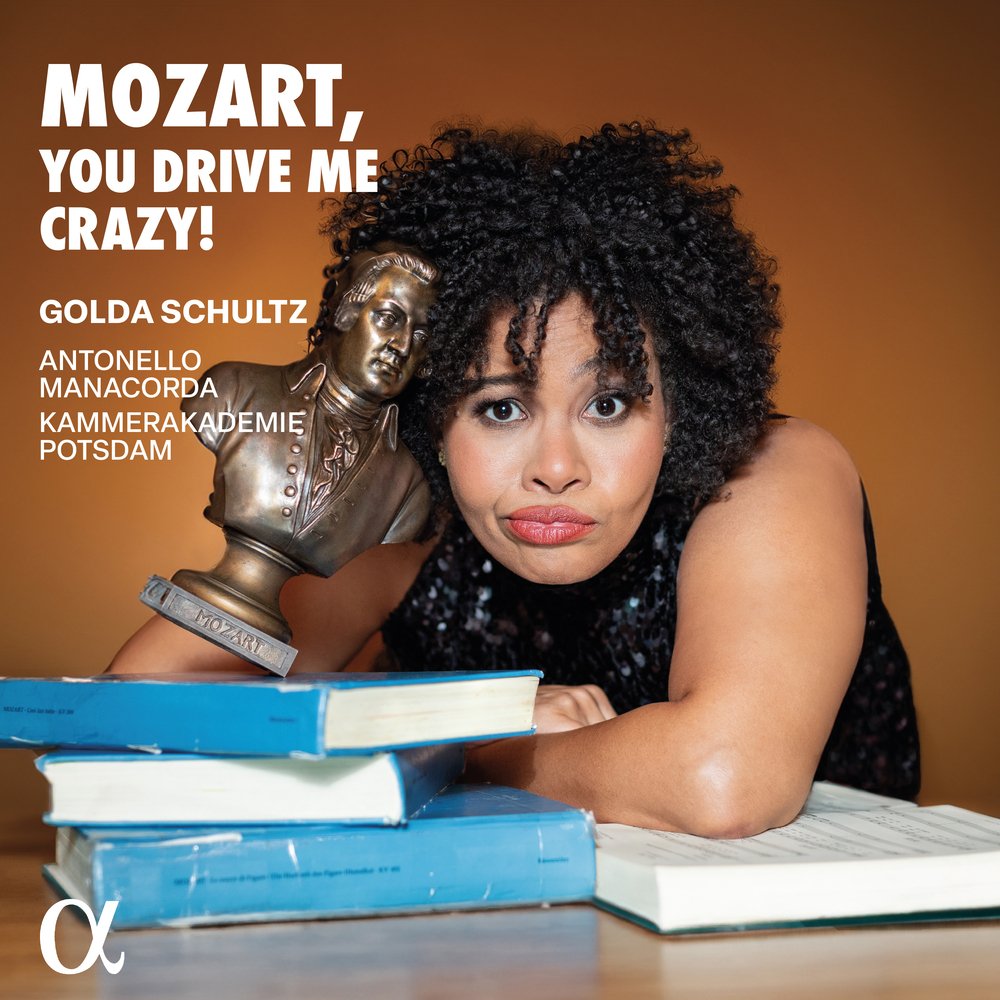


We hear early on in Mozart’s Don Giovanni that the title cad has seduced 1,800 women, but the people seduced by the opera since its premiere in 1787 is far too many to fit in Leporello’s little black book.